Why aren't civilized countries demanding an end to this? Do they just stop with chemical weapons and walk away?
Human Rights Watch: "All nations should urge Syria to immediately stop using incendiary weapons and should work to strengthen international law on these weapons."
LINK: Syria: Widespread Use of Incendiary Weapons - YouTube
Showing posts with label Human Rights Watch. Show all posts
Showing posts with label Human Rights Watch. Show all posts
Sunday, November 10, 2013


Monday, May 27, 2013
Libya: Seize Chance to Protect Women’s Rights | Human Rights Watch
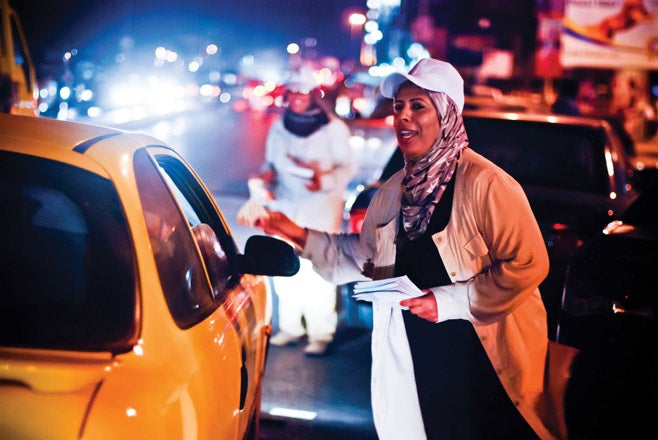 Amal Mohamed B’ayou, an independent candidate in Benghazi, handed out election pamphlets in front of the courthouse on July 6, 2012. “For 42 years men have ruled Libya,” B’ayou said. “Now it’s time for the women to rule.” © 2012 Samer Muscati/Human Rights Watch
Human Rights Watch New Report:
- Women’s Rights in the New LibyaMay 27, 2013


(Tripoli) – Libyan authorities should seize a historic opportunity to promote and protect women’s rights as the country transitions from four decades of dictatorship, Human Rights Watch said in a new report released today.

The parliament, government, and other bodies should ensure that women can participate actively and equally in the drafting of the new constitution and the reform of legislation that affect their lives, Human Rights Watch said.
“Libyan women are at a pivotal moment in their country’s history with the drafting of a new constitution and the start of legislative reform,” said Liesl Gerntholtz, women’s rights director at Human Rights Watch. “If Libya misses this opportunity to lay the legal foundation for women’s rights, it could lead to serious violations for years to come.”
The 40-page report, “A Revolution for All: Women’s Rights in the New Libya,” highlights key steps that Libya should take to meet its international obligations by firmly rejecting gender-based discrimination in both law and practice...........
LINK TO ALL: Libya: Seize Chance to Protect Women’s Rights | Human Rights Watch
Wednesday, May 2, 2012
Syria: War Crimes in Idlib During Peace Negotiations
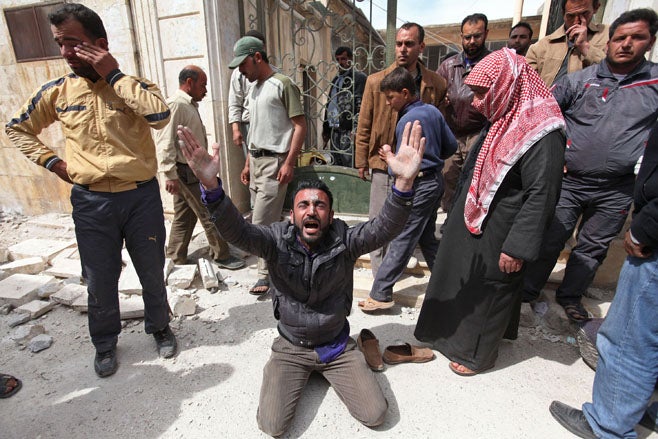
A man is overcome with grief
in front of a destroyed mosque in Taftanaz where local residents
gathered those killed after government forces attacked the town on April
3 and 4. According to local activists, at least 65 people were killed
during the two-day attack.
(New York) – Syrian government forces killed at least 95 civilians and
burned or destroyed hundreds of houses during a two-week offensive in
northern Idlib governorate shortly before the ceasefire, Human Rights
Watch said in a report released today. The attacks happened in late
March and early April, as United Nations special envoy Kofi Annan was
negotiating with the Syrian government to end the fighting.
The 38-page report, “ ‘They Burned My Heart’: War Crimes in Northern Idlib during Peace Plan Negotiations,” documents dozens of extrajudicial executions, killings of civilians, and destruction of civilian property that qualify as war crimes, as well as arbitrary detention and torture. The report is based on a field investigation conducted by Human Rights Watch in the towns of Taftanaz, Saraqeb, Sarmeen, Kelly, and Hazano in Idlib governorate in late April.
“While diplomats argued over details of Annan’s peace plan, Syrian tanks and helicopters attacked one town in Idlib after another,” said Anna Neistat, associate director for program and emergencies at Human Rights Watch. “Everywhere we went, we saw burnt and destroyed houses, shops, and cars, and heard from people whose relatives were killed. It was as if the Syrian government forces used every minute before the ceasefire to cause harm.”
The 38-page report, “ ‘They Burned My Heart’: War Crimes in Northern Idlib during Peace Plan Negotiations,” documents dozens of extrajudicial executions, killings of civilians, and destruction of civilian property that qualify as war crimes, as well as arbitrary detention and torture. The report is based on a field investigation conducted by Human Rights Watch in the towns of Taftanaz, Saraqeb, Sarmeen, Kelly, and Hazano in Idlib governorate in late April.
“While diplomats argued over details of Annan’s peace plan, Syrian tanks and helicopters attacked one town in Idlib after another,” said Anna Neistat, associate director for program and emergencies at Human Rights Watch. “Everywhere we went, we saw burnt and destroyed houses, shops, and cars, and heard from people whose relatives were killed. It was as if the Syrian government forces used every minute before the ceasefire to cause harm.”
Sunday, April 29, 2012
China: Protect Chen Guangcheng From Extrajudicial Violence | Human Rights Watch

New York) – The Chinese government should immediately guarantee blind human rights defender Chen Guangcheng’s safety, end its persecution of him and his family, and ensure that he is not returned to any form of detention or subject to any restrictions on his rights, Human Rights Watch said today. Human Rights Watch has been calling for Chen’s release since 2006.
Chen, a blind legal activist, is reported to have escaped from his home village of Dongshigu in Shandong province on April 22, 2012, after 19 months of unlawful detention. According to activists, Chen is reportedly in a “100% safe location” in Beijing. Chen described his escape in a video circulated on the Chinese-language website Boxun earlier today. In the video, Chen appeals to Chinese Prime Minister Wen Jiabao to “personally intervene” by opening an investigation on Chen and his family’s confinement and “those who ordered county-level police and officials to break into my house, beat and hurt me, refused me medical attention – without any legal foundation or officers wearing uniforms.”
“The central government has for years condoned, abetted, and possibly directed the human rights abuses visited upon Chen and his family,” said Sophie Richardson, China director at Human Rights Watch. “We’re well past the time when the government should focus on the conduct of officials in Shandong, and cease persecution of someone whose activism is wholly legal.”
In June 2005, Chen filed a class action lawsuit accusing officials in Linyi, Shandong Province, of seeking to enforce strict population control laws by subjecting thousands of people to forced abortions and sterilization.
Friday, March 16, 2012
Justice in Congo | Human Rights Watch
HRW PRESS RELEASE:
A Victory for Congo's Children
- Lubanga in the courtroom at the International Criminal Court.© 2010 Reuters
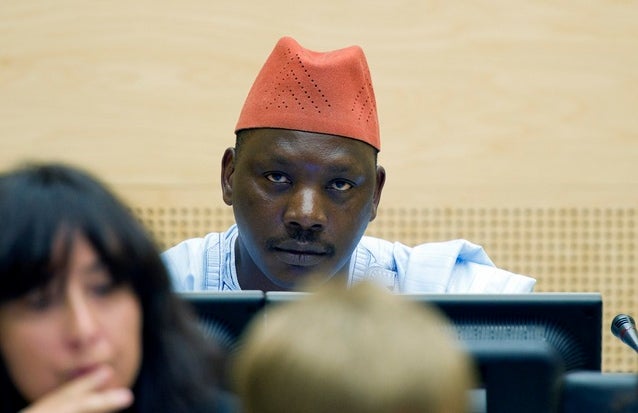

Yesterday in The Hague, the International Criminal Court (ICC) found the Congolese warlord Thomas Lubanga guilty of recruiting and using child soldiers under age 15 in the Democratic Republic of Congo, making him the ICC’s first convicted war criminal. Human Rights Watch extensively documented his abuses in the Congo and pushed for him to be held accountable.
Lubanga’s name is not as quickly recognizable as Joseph Kony’s, because of the Kony 2012 viral video that educated nearly 80 million people on the atrocities of Kony’s rebel group, the Lord’s Resistance Army (LRA). But like Kony, Lubanga has the blood of many Congolese on his hands and is one of the most infamous present-day recruiters of child soldiers.
Lubanga was the leader of the Union of Congolese Patriots (UPC), a rebel group implicated in ethnic massacres, torture, and rape in the Ituri district of northeastern Congo. There, government armies and numerous armed militias, often divided along ethnic lines, fought for the region’s lucrative gold mines and trade routes – and the resulting money, guns, and power. More than 60,000 civilians were slaughtered in the Ituri conflict between 1999 and 2006. Thousands of children were recruited, often by force, into the ranks of Lubanga’s UPC and other armed groups. The children were so prevalent in the UPC’s ranks that it was called “an army of children.”
Lubanga’s conviction is a landmark for international justice as the first ICC judgment. But it is especially important for the Congolese victims, who have long sought justice. Human Rights Watch began documenting war crimes in Ituri in 1999, and we have repeatedly called for the arrest of those responsible. We encouraged the ICC prosecutor to investigate the crimes in Ituri and, together with a courageous local human rights group, we provided assistance, where we could, to ensure that justice was done.
We have also worked to make sure the legal proceedings against Lubanga at The Hague were meaningful for his victims in Congo. We pressed the ICC’s victims and witnesses unit to reach out to the Congolese people – including those in remote villages in Ituri. We shared with the ICC our regional knowledge and our tips and strategies for operating in Congo. We monitored Lubanga’s trial and created documents and news releases to explain what was happening during the trial’s critical moments.
Yesterday’s verdict was a stark warning to all those who recruit children for use in combat. In particular, it shines a spotlight on others who are wanted on arrest warrants from the ICC for this crime – most notably Kony and Bosco Ntaganda.
Ntaganda is the co-accused in the Lubanga trial and has so far evaded arrest. He is a general in the Congolese army and lives openly in Goma, eastern Congo, where he has been implicated in more horrific abuses against civilians – including the recruitment of child soldiers. Human Rights Watch documents his crimes and the urgent need to arrest him.
In another advance for justice, today the ICC prosecutor announced he would press additional charges of murder and rape against Ntaganda and would meet with the Congo’s President Joseph Kabila to push for Ntaganda’s arrest. Human Rights Watch has been advocating such additional charges for both Ntaganda and Lubanga. We’re also urging the ICC prosecutor to investigate additional crimes allegedly committed by Ntaganda in eastern Congo’s Kivu provinces.
Most of Congo’s warlords seem to think they can terrorize people and never be held accountable for their crimes. But with Lubanga’s guilty verdict, this could be about to change.
Lubanga’s name is not as quickly recognizable as Joseph Kony’s, because of the Kony 2012 viral video that educated nearly 80 million people on the atrocities of Kony’s rebel group, the Lord’s Resistance Army (LRA). But like Kony, Lubanga has the blood of many Congolese on his hands and is one of the most infamous present-day recruiters of child soldiers.
Lubanga was the leader of the Union of Congolese Patriots (UPC), a rebel group implicated in ethnic massacres, torture, and rape in the Ituri district of northeastern Congo. There, government armies and numerous armed militias, often divided along ethnic lines, fought for the region’s lucrative gold mines and trade routes – and the resulting money, guns, and power. More than 60,000 civilians were slaughtered in the Ituri conflict between 1999 and 2006. Thousands of children were recruited, often by force, into the ranks of Lubanga’s UPC and other armed groups. The children were so prevalent in the UPC’s ranks that it was called “an army of children.”
Lubanga’s conviction is a landmark for international justice as the first ICC judgment. But it is especially important for the Congolese victims, who have long sought justice. Human Rights Watch began documenting war crimes in Ituri in 1999, and we have repeatedly called for the arrest of those responsible. We encouraged the ICC prosecutor to investigate the crimes in Ituri and, together with a courageous local human rights group, we provided assistance, where we could, to ensure that justice was done.
We have also worked to make sure the legal proceedings against Lubanga at The Hague were meaningful for his victims in Congo. We pressed the ICC’s victims and witnesses unit to reach out to the Congolese people – including those in remote villages in Ituri. We shared with the ICC our regional knowledge and our tips and strategies for operating in Congo. We monitored Lubanga’s trial and created documents and news releases to explain what was happening during the trial’s critical moments.
Yesterday’s verdict was a stark warning to all those who recruit children for use in combat. In particular, it shines a spotlight on others who are wanted on arrest warrants from the ICC for this crime – most notably Kony and Bosco Ntaganda.
Ntaganda is the co-accused in the Lubanga trial and has so far evaded arrest. He is a general in the Congolese army and lives openly in Goma, eastern Congo, where he has been implicated in more horrific abuses against civilians – including the recruitment of child soldiers. Human Rights Watch documents his crimes and the urgent need to arrest him.
In another advance for justice, today the ICC prosecutor announced he would press additional charges of murder and rape against Ntaganda and would meet with the Congo’s President Joseph Kabila to push for Ntaganda’s arrest. Human Rights Watch has been advocating such additional charges for both Ntaganda and Lubanga. We’re also urging the ICC prosecutor to investigate additional crimes allegedly committed by Ntaganda in eastern Congo’s Kivu provinces.
Most of Congo’s warlords seem to think they can terrorize people and never be held accountable for their crimes. But with Lubanga’s guilty verdict, this could be about to change.
Thursday, March 8, 2012
Syria: New Satellite Images Show Homs Shelling | Human Rights Watch
Russia and China Fail to Act While Residents Suffer Death, Destruction
- © 2012 DigitalGlobe, Analysis provided by Human Rights Watch

These new satellite photos and witness accounts show the extent of the brutality unleashed on Baba Amr. Despite the killing, Russia and China continue to block any international action.
Sarah Leah Whitson, Middle East director at Human Rights Watch
Sarah Leah Whitson, Middle East director at Human Rights Watch
(New York) – New satellite imagery and eyewitness accounts reveal that the bombardment of the Baba Amr neighborhood in Homs has inflicted widespread destruction and a large number of deaths and severe injuries of civilians, Human Rights Watch said today. The bombardment has severely restricted movement and relief efforts and deprived thousands of civilians of the ability to access the most basic commodities, Human Rights Watch said.
Local sources have reported that approximately 700 civilians have been killed and thousands wounded in Homs since the Syrian military began its current assault on the city on February 3, 2012. Indiscriminate shelling and sniper fire has caused most of the casualties in Baba Amr, which is a residential area where elements of the armed opposition have sought refuge. Human Rights Watch interviewed 15 Homs residents who escaped the city in the last two weeks, as well as two foreign correspondents who spent time in Baba Amr during the military assault.
“These new satellite photos and witness accounts show the extent of the brutality unleashed on Baba Amr," said Sarah Leah Whitson, Middle East director at Human Rights Watch. “Despite the killing, Russia and China continue to block any international action.”
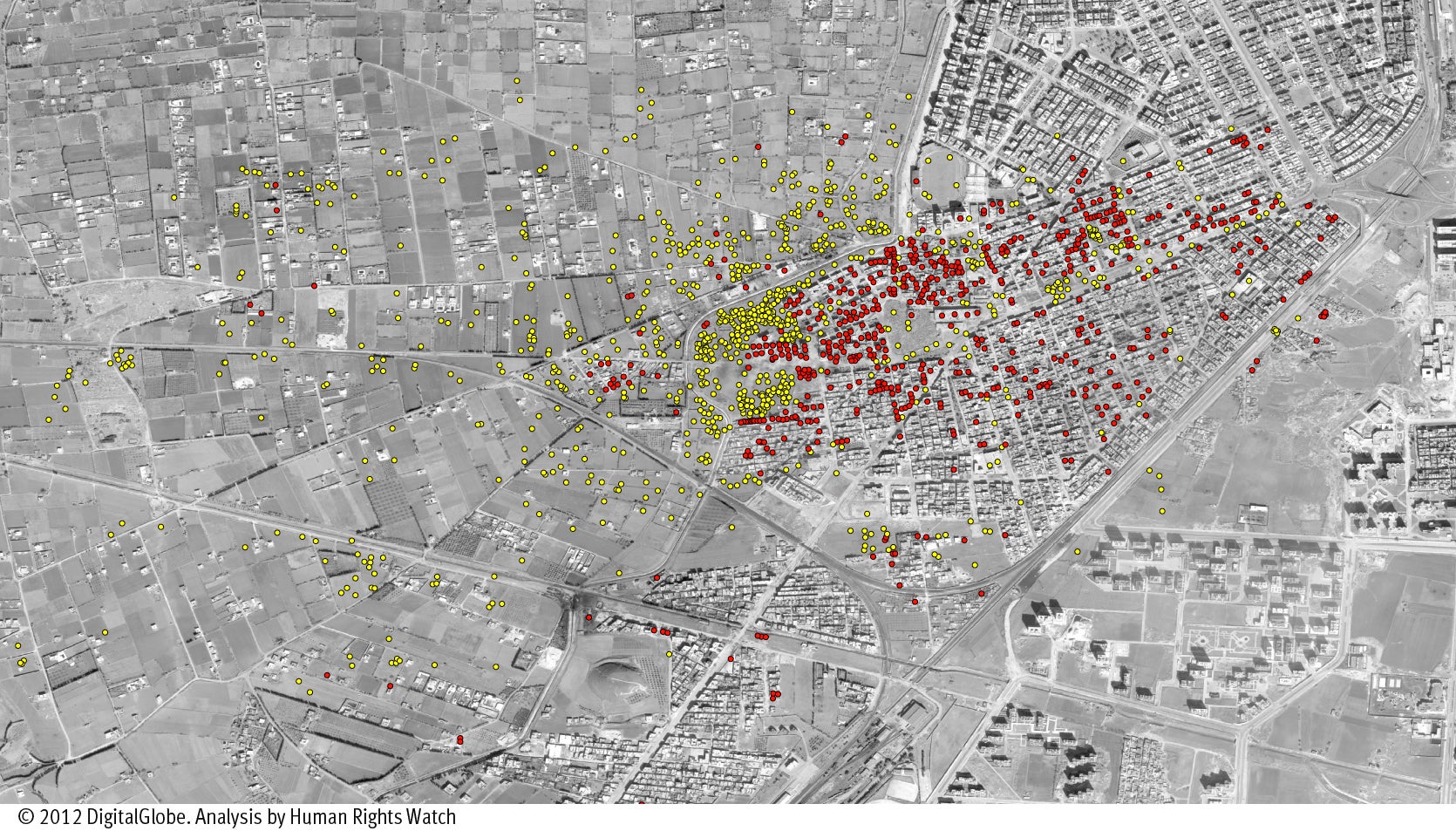
Human Rights Watch acquired and analyzed this commercial satellite image of the Baba Amr neighborhood of Homs on February 25. A wide view of the image clearly shows the extensive damage caused by the use of surface-delivered explosive weapons in a populated area. The image reflects the damage that has occurred since previous images were taken between four and six weeks ago.
Local sources have reported that approximately 700 civilians have been killed and thousands wounded in Homs since the Syrian military began its current assault on the city on February 3, 2012. Indiscriminate shelling and sniper fire has caused most of the casualties in Baba Amr, which is a residential area where elements of the armed opposition have sought refuge. Human Rights Watch interviewed 15 Homs residents who escaped the city in the last two weeks, as well as two foreign correspondents who spent time in Baba Amr during the military assault.
“These new satellite photos and witness accounts show the extent of the brutality unleashed on Baba Amr," said Sarah Leah Whitson, Middle East director at Human Rights Watch. “Despite the killing, Russia and China continue to block any international action.”
Human Rights Watch acquired and analyzed this commercial satellite image of the Baba Amr neighborhood of Homs on February 25. A wide view of the image clearly shows the extensive damage caused by the use of surface-delivered explosive weapons in a populated area. The image reflects the damage that has occurred since previous images were taken between four and six weeks ago.

© 2012 DigitalGlobe, Analysis provided by Human Rights Watch
Analysts have overlaid the large-scale image of Baba Amr with symbols to highlight certain features:
- Red circles represent destroyed or damaged buildings
- Yellow circles are impact craters in open areas like fields, or roads.
Subscribe to:
Posts (Atom)