GANDHI has been all over New York lately. First he appeared at Occupy Wall Street as a patron saint of sorts, inspiring the protest’s nonviolent tactics. (The demonstrators even named a lane for him.) Then he emerged at the Metropolitan Opera as the star of Philip Glass’s opera “Satyagraha.”
But with the Zuccotti Park encampment removed, and the opera closing on Dec. 1, is that it for Gandhi in New York? Or is it worth asking, what would Gandhi do in the world today?
Throughout his life, Gandhi was preoccupied with putting universal morals into practice. In doing so, he attempted to dissolve the division between ideas and action. This blend of ideas and action animates Mr. Glass’s “Satyagraha.” During the almost four-hour performance, Gandhi’s career as a young freedom fighter is set in the context of his intellectual debts to Tolstoy, Tagore and above all the Bhagavad Gita.
Along the way, the opera reveals the often-overlooked fact that Gandhi’s accomplishments were enabled by a core group of spirited collaborators amid a larger body of followers. In capturing the political drama of Gandhi’s life, the roots of his intellectual universe, and his reliance on the community he led, “Satyagraha” gives us a richer vision of Gandhi than most contemporary portraits of the Mahatma.
Syria’s military and security forces have committed crimes against humanity, including murder, torture and rape in their brutal crackdown on anti-regime protesters, U.N.-appointed investigators said on Monday.
The commission added that the government of President Bashar al-Assad bore responsibility for the crimes.
“The commission is gravely concerned that crimes against humanity have been committed in different locations in the Syrian Arab Republic during the period under review,” the Independent Commission of Inquiry on Syria said in its report, concluding that military and security forces were behind the acts.
“It calls upon the Government of the Syrian Arab Republic to put an immediate end to the ongoing gross human rights violations, to initiate independent and impartial investigations of these violations and to bring perpetrators to justice,” it wrote in its summary.
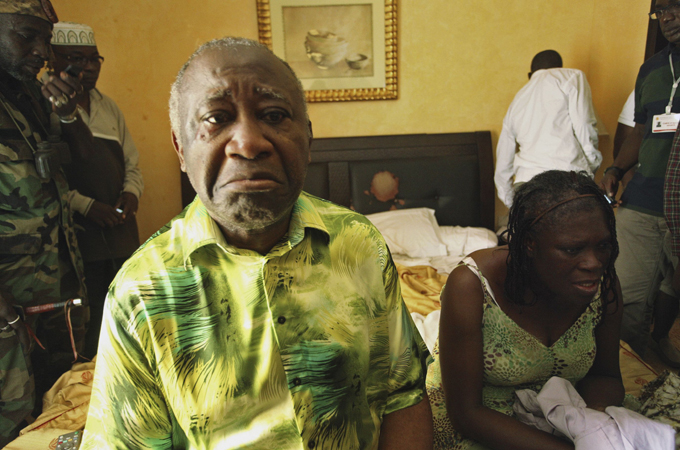
Gbagbo was captured in a bunker in April by pro-Ouattarra forces and placed under house arrest [File/Reuters]
The former president of the Ivory Coast has been escorted to the Netherlands in International Criminal Court (ICC) custody hours after the court in The Hague issued an arrest warrant for him.
Laurent Gbagbo arrived by plane at Rotterdam airport early on Wednesday to face an investigation by the ICC into killings, rapes and other abuses committed in the West African nation during a four-month conflict triggered by his refusal to cede power to Alassane Ouattara after last year's election.
The Ivory Coast plane landed at Rotterdam airport at 02:44 GMT and entered a hangar, a Reuters witness said.
Gbagbo had been flown by helicopter on Tuesday from remote Korhogo in northern Ivory Coast, where he had been under house arrest since his capture, and transferred on to a plane, Ivorian military officials said.
Ouattara's forces, backed by French and UN troops, deposed Gbagbo in April and he has since been placed under house arrest in the northern town of Korhogo.
"They [Ivorian justice authorities] showed him the arrest warrant this morning," Bourthoumieux said by telephone from France, questioning the competence of the ICC to try Gbagbo.
The first elections in Egypt since former President Hosni Mubarak was overthrown are going into a second day with indications of a high turnout in Cairo and other big cities.
The first day of polling for a new parliament was mainly peaceful.
Voting was extended to cope with long queues and few security problems were reported.
Many protesters occupying Cairo's Tahrir Square have boycotted the vote.
There had been fears the vote might be delayed after deadly protests against the interim military rulers who replaced Mr Mubarak.
Ever since September, when activists heeded Adbusters editor Kalle Lasn’s call to Occupy Wall Street, it’s become a rite of passage for reporters, bloggers, and video trackers to go to the occupiers’ tent cities and comment on what they see. Last week, the day after New York mayor Michael Bloomberg ordered the NYPD to dismantle the tent city in Zuccotti Park in Lower Manhattan, the New York Times carried no fewer than half a dozen articles on the subject. Never in living memory has such a small political movement received such disproportionate attention from the press. Never in living memory has a movement been so widely scrutinized and yet so deeply misunderstood.
AP / Seth Wenig
If income equality is the new political religion, occupied Zuccotti Park was its Mecca. Liberal journalists traveled there and spewed forth torrents of ink on the value of protest, the creativity and spontaneity of the occupiers, the urgency of redistribution, and the gospel of social justice. Occupy Wall Street was compared to the Arab Spring, the Tea Party, and the civil rights movement. Yet, as many a liberal journalist left the park, they lamented the fact that Occupy Wall Street wasn’t more tightly organized. They worried that the demonstration would dissipate without a proper list of demands or a specific policy agenda. They suspected that the thefts, sexual assaults, vandalism, and filth in the camps would limit the occupiers’ appeal.
The conservative reaction has been similar. A great many conservatives stress the conditions among the tents. They crow that Americans will never fall in line behind a bunch of scraggly hippies. They dismiss the movement as a fringe collection of left tendencies, along with assorted homeless, mental cases, and petty criminals. They argue that the Democrats made a huge mistake embracing Occupy Wall Street as an expression of economic and social frustration.
The “realist” case for Bashar al-Assad—and before him, for his father, Hafez—was that he was supposedly a pillar of stability. The Assads, we were told, were all that stood between Syria and chaos. If that was ever true, it definitely is not true now. Assad’s heavy-handed attempt to repress a revolution is not cowing the protesters. Instead it is leading growing numbers of them to take up arms. Soldiers are defecting to the Free Syrian Army, which in recent days has reportedly attacked an intelligence headquarters outside of Damascus and a Baath party headquarters inside the capital.
Syrian protesters demonstrating against Syria’s president Bashar al-Assad at the Arab League headquarters in Cairo, November 12
Newscom
Homs, Syria’s third-largest city, is descending into civil war with, in the words of a New York Times correspondent, “supporters and opponents of the government blamed for beheadings, rival gangs carrying out tit-for-tat kidnappings, minorities fleeing for their native villages, and taxi drivers too fearful of drive-by shootings to ply the streets.” This could be a vision of what all of Syria might become if Assad continues to cling to power—as he shows every sign of trying to do.
Indeed, Assad recently vowed defiance to the Sunday Times of London, telling a reporter he “will not bow down” despite growing international pressure, such as the European Union’s decision to stop buying Syrian oil and the Arab League’s decision to suspend Syria from membership. It is not only Barack Obama, Nicolas Sarkozy, and other Westerners who are telling Assad to step down. The same message is coming from the leaders of neighboring Turkey and Jordan. Even Hamas, long headquartered in Damascus, is backing away from Assad. His actions are beyond the pale for a terrorist group—that tells you something.
Abdelillah Benkirane, secretary-general of PJD said his party is 'open to everyone' wanting to form alliances [Reuters]
The Party of Justice and Development (PJD), a moderate Islamic party, has taken a resounding victory in Morocco's parliamentary elections, Taib Cherkaoui, the country's interior minister, has announced.
Cherkaoui told a press conference on Saturday that PJD had won 80 seats from 288 seats announced out of the 395 up for grabs in the nationwide vote.
That is nearly double the 45 seats won by Prime Minister Abbas el Fassi's Independence Party which finished second and has headed a five-party coalition government since 2007.
Cherkaoui, whose ministry organised the election, said that complete results, including those of 90 seats reserved for women and youth and the 23 remaining regular seats, will be announced on Sunday The PJD is expected to ultimately win up to 110 seats.
The seat of the Foreign Minister of Syria is seen empty during a meeting for Arab foreign ministers in Cairo, to discuss the situation in Syria Nov. 24, 2011. (Reuters)
By Al Arabiya with Agencies CAIRO Arab finance ministers gathered in Cairo on Saturday drew up a list of sanctions against Syria that they will present to foreign ministers for adoption as fresh violence killed 24 civilians and members of the security forces.
The recommendation of the Arab economic and social council - which includes a ban on Syrian officials visiting any Arab country and the freezing of government assets - comes after President Bashar al-Assad’s regime defied an ultimatum to allow in observers amid a lethal crackdown on protest.
Syrian Foreign Minister Walid Muallem earlier accused the Arab League on Saturday of “internationalizing” the deadly crisis hitting the country since pro-democracy protests began more than eight months ago.
The list of punitive measures also included the suspension of flights and a halt to any transactions with the Syrian government and its central bank.
Etienne Tshisekedi was blocked in at the airport by police for eight hours
Tension is high in Kinshasa, the capital of the Democratic Republic of Congo, after violence at pre-election rallies left at least two people dead.
Supporters of President Joseph Kabila and the main opposition candidate, Etienne Tshisekedi, pelted each other with stones and police fired tear gas.
Final rallies were due to be held on Saturday ahead of Monday's parliamentary and presidential vote.
But police banned them at the last minute after the violence.
"Because of the escalating violence seen in Kinshasa, all public demonstrations and other political meetings are cancelled this Saturday," Governor Andre Kimbuta said. "This is for a better result of the electoral process."
Mr Kabila and his two main rivals had been due to hold rallies within several hundred metres of each other, at the capital's main stadium
This is Al Jazeera's powerful investigative series on modern slavery throughout the planet. No country, officials say, is untouched by this recurring scourge of inhumanity and depravity that enslaves, reports say, some 27,000,000 men, women and children. Although slavery has often morphed in form from classic scenarios, it still shares these common conditions: 1) victims of slavery cannot escape the complete control of their enslavers; 3) they are controlled through violence and threats; 3) They are economically exploited. This series of nine videos will educate and upset you.
Hisham Matar’s first novel had huge political resonance in Libya, but both that and his recent second work are personal, human tales at heart, he tells Sophie McBain
‘I DIDN’T SIT down and think, “I want to write a political book that would inspire, that would expose the nature of life under the Gaddafi regime.” That wasn’t my intention at all. In fact, if I could have, I would have avoided it, because it created a great deal of anxiety for me and for lots of people I know,’ Hisham Matar insists.
It is a surprising admission, because his first novel, In the Country of Men, shortlisted for the Man Booker Prize in 2006, did precisely that. At a time when Muammar Gaddafi had successfully painted himself as the ultimate nuclear-bad-guy-turned-good, when Saif al Islam Gaddafi was studiously learning the language of democracy (or possibly paying others to do it for him) at LSE, and when regime strongmen were putting away their army uniforms and donning their best business suits, Matar penned a quietly haunting portrait of the Tripoli of his childhood in the late Seventies: a city of chain-smoking mokhabarat (secret police) and power-hungry telltale neighbours, where schoolchildren watched public hangings on TV, fathers disappeared and returned unrecognisable and teenage brides drowned their dashed hopes with illegal grappa.
In the Country of Men was one of the few books I brought with me when I first arrived in Tripoli in late 2008 and moved into Girgaresh, the same well-heeled suburb described in the novel. My first disorienting days in the city were filtered through Matar’s deliberate, measured prose.
While a lot had changed since the Seventies, an equal amount hadn’t. The secret police still lurked outside houses in shiny new cars and cheap leather jackets, exuding tobacco smoke and violence. Phones were tapped, houses bugged. Sometimes people went missing, more often they lived with a constant, niggling anxiety. And Girgaresh was still known for the ‘butchers that don’t sell meat’ and ‘bakers with no bread’ where Libyans found guilty solace in bocha (date alcohol), for expats the key ingredient for the bojito, the Tripoli party tipple of choice.
I felt a jolt of panic when a Libyan friend of mine spotted In the Country of Men, but he surprised me by grabbing it off the shelf and asking to borrow it. I never saw the book again: it was passed from friend to friend, as they pored over pages describing a chapter in Libyan history of which their parents never dared speak.
Egypt's ruling military council has asked a former prime minister, Kamal al-Ganzouri, with forming a new cabinet, according to private TV channels, with no signs of a let-up in anti-military demonstrations, Ganzouri headed the government from 1996 to 1999, under the deposed president, Hosni Mubarak.
The state newspaper Al-Ahram said on its website, quoting sources close to Ganzouri, that he had had agreed in principle to lead a national government after his meeting with Field Marshal Mohamed Hussein Tantawi, head of the Supreme Council of the Armed Forces (SCAF).
The military council earlier accepted the resignation of caretaker prime minister Essam Sharaf's cabinet, amid continued unrest in Cairo and other major cities.
After the popular uprisings earlier this year, Ganzouri distanced himself from Mubarak in a television interview, prompting several Facebook pages to recommend him as a future presidential candidate.
Born in 1933, Ganzuri served as minister of planning and international co-operation before his first tenure as prime minister. He then made a name for himself by working to strengthen ties between Egypt and the World Bank and the International Monetary Fund.
The resolution was passed by 122 votes to 13 with 41 abstentions at the U.N. General Assembly’s human rights committee. (Reuters)
By Al Arabiya with Agencies
The U.N. General Assembly’s human rights committee on Tuesday condemned Syria for its eight-month crackdown on pro-democracy demonstrators in a vote backed by Western nations and a number of Arab states.
The resolution was passed by 122 votes to 13 with 41 abstentions at the U.N. General Assembly’s human rights committee. Syria’s U.N. envoy accused the European backers of the resolution – Britain, France and Germany – of “inciting civil war.”
The resolution “strongly condemns the continued grave and systematic human rights violations by the Syrian authorities,” highlighting the “arbitrary executions” and “persecution” of protesters and human rights defenders.
It also condemns “arbitrary detention, enforced disappearances, torture and ill treatment of detainees, including children” and demands an immediate end to all such violations.
Arab nations Bahrain, Saudi Arabia, Jordan, Kuwait, Morocco and Qatar were among more than 60 countries to co-sponsor the resolution.
Russia and China, which vetoed a European-drafted resolution that would have condemned Syria in the U.N. Security Council last month, voted against it.
Egypt's military rulers have completely failed to live up to their promises to Egyptians to improve human rights and have instead been responsible for a catalogue of abuses which in some cases exceeds the record of Hosni Mubarak, Amnesty International said today in a new report.
In Broken Promises: Egypt's Military Rulers Erode Human Rights, the organization documents a woeful performance on human rights by the Supreme Council of Armed Forces (SCAF) which assumed power after the fall of former President Hosni Mubarak in February.
The report's release follows a bloody few days in Egypt that has left many dead and hundreds injured after army and security forces violently attempted to disperse anti-SCAF protesters from Cairo’s Tahrir square.
"By using military courts to try thousands of civilians, cracking down on peaceful protest and expanding the remit of Mubarak's Emergency Law, the SCAF has continued the tradition of repressive rule which the January 25 demonstrators fought so hard to get rid of," said Philip Luther, Amnesty International’s Middle East and North Africa Acting Director.
"Those who have challenged or criticized the military council - like demonstrators. journalists, bloggers, striking workers - have been ruthlessly suppressed, in an attempt at silencing their voices.
"The human rights balance sheet for SCAF shows that after nine months in charge of Egypt, the aims and aspirations of the January 25 revolution have been crushed. The brutal and heavy-handed response to protests in the last few days bears all the hallmarks of the Mubarak era."
Amnesty International found in its review of human rights under the SCAF that the military council had met few of the commitments it made in its many public statements and had worsened the situation in some areas.
By August, the SCAF admitted that some 12,000 civilians across the country had been tried by military courts following grossly unfair trials. At least 13 have been sentenced to death.
Charges against defendants have included “thuggery”, “breaking the curfew”, “damaging property” and “insulting the army”.
The case of prisoner of conscience Maikel Nabil Sanad, a blogger sentenced to three years in prison in April for criticizing the military and objecting to military service, has become symbolic. After going on hunger strike in August, prison authorities have denied him the medication he needs to treat a heart condition. He continues to be held in prison as his case is being reviewed by another court following an appeal in October.
In a clear attempt to suppress negative media reporting about the SCAF, scores of journalists and broadcasters have been summoned to the military prosecutor. Pressure from the military has led to a number of major current affairs shows being cancelled.
The SCAF promised in early statements to “carry out their leading role in protecting protesters regardless of their views” but security forces, including the army, have violently suppressed several protests, resulting in deaths and injuries.
Twenty-eight people are believed to have been killed on 9 October after security forces dispersed a protest by Coptic Christians. Medics told Amnesty International that casualties included bullet wounds and crushed body parts, after people were run over by speeding armoured vehicles. Instead of ordering an independent investigation, the army announced that it would carry out the investigation itself and moved quickly to suppress criticism.
Muammar Qaddafi’s intelligence chief Abdallah Senoussi, wanted by the International Criminal Court, has been captured near the southern town of Sabha, where he was hiding at his sister’s house, Al Arabiya correspondent reported on Sunday, quoting Libya’s National Transitional Council.
A day after Qaddafi’s son Saif al-Islam was captured in the same general region, Abdul Hafiz Ghoga confirmed in a news conference that Senoussi, the elder Qaddafi’s brother-in-law and loyal confidant, had been seized. Earlier, an NTC military official said Senoussi,had been surrounded at a house owned by his sister.
The Al Arabiya corresponded said NTC fighters from Zintan, in coordination from Sabha fighters, captured Senoussi, but that it was not clear where they were keeping him.
The International Criminal Court indicted Senoussi, 62, along with Qaddafi and Seif al-Islam in June this year for war crimes over alleged armed attacks on civilians in anti-Qaddafi regions shortly after the onset of the uprising in February.
Soon after the revolt blew up, media reports said that Senoussi had joined then-foreign minister Moussa Koussa in defecting. These reports about al- Senoussi were later denied.
A U.S. national security official said U.S. government agencies were aware that Senoussi, together with Seif al-Islam, had been involved in making some early peace overtures to rebels but they were rejected.
A Libyan woman who claims she was raped for five years by former leader Muammar Qaddafi says she is still haunted by memories of sexual assault and captivity. (File photo)
By Amal al-Hilali
Al Arabiya Dubai
Muammar Qaddafi might have physically disappeared but his specter will apparently keep haunting a lot of Libyans for some time to come. One such person is Safiya, a woman who alleges that the former Libyan leader had been raping her for five whole years and who has finally decided to tell her story.
“Qaddafi destroyed my life.” That is how Safiya, who is not yet 22, began her story as told to Le Monde correspondent in Tripoli.
“I wish he were not dead so he could be tried for all the crimes he committed in cold blood against Libyan women.”
Safiya felt a mixture of happiness and bitterness at the sight of Qaddafi’s lifeless body in a fridge in Misrata; she was happy he was gone yet bitter because there were many questions she wanted to ask him.
“I wanted to ask him why he did all that to me, why he took me from my parents, why he violated my honor and destroyed my youth.”
Muammar Gaddafi's son and one-time heir apparent Saif al-Islam has been detained in the southern desert, Libya's interim justice minister and other officials have said.
Fighters from the western mountain city of Zintan announced his capture on Saturday as gunfire and car horns marked jubilation across the country at the arrest of the British-educated 39-year-old who a year ago seemed set to follow his father as Libya's leader.
Saif al-Islam and three armed companions were taken without a fight during the night, officials said. Gaddafi's son was reportedly not injured, unlike Gaddafi himself, who was killed last month after being captured by fighters in his home town of Sirte.
Libyan Prime Minister Abdul Raheem al-Keeb officially announced the capture of Saif al-Islam Gaddafi during a news conference on Saturday evening, assuring Libyans and rest of the world he will face a fair trial.
"Because of this historic occasion, I would like to congratulate the men and women of Libya and the rebels of Libya, for their struggle, determination and heroism, which gave way to such victory," al-Keeb said to a cheering audience.
Seif al-Islam Qaddafi, the son of the former Libyan leader, has been arrested in the south of the country, NTC official in charge of Justice Mohammed al-Allaqi told Al Arabiya.
An NTC commander told reporters from Tripoli that Seif al-Islam was arrested near the town of Oubari along with three of his aids.
American freelancer Abdallah Omeish, who was born in Libya, has won this year's Rory Peck Award for Features, for his Benghazi film, Libya: Through the Fire - a portrait of the city, and one of its sons, Mohammed al-Nabbous - the first person to broadcast from within Libya and report on events in English and Arabic. Judges said the film was moving and powerful and felt the central character of Nabbous embodied the story of the Arab Spring.
There are an estimated 1.4 million sex slaves in the world today; most of them are women, although there are some men and many thousands of children.
They didn't listen. They kept bringing me clients and telling me that I had a huge debt towards them. For the fact they paid for my visa, passport and tickets." (Dorina, a former sex slave from Moldova)
These women do not voluntarily enter prostitution, but have been forced under the threat of violence to have sex with men who pay their 'owners'.
Sex slavery is present in every country of the world.
In some cases, categorised as 'domestic', women are sold into brothels within their own country. But international sex trafficking of women and children is on the rise.
Syrian activists say that army defectors have attacked an intelligence complex in the Damascus suburbs, according to the Reuters news agency.
If confirmed, the attack would be the first reported assault on a major security facility in the eight-month uprising against President Bashar al Assad.
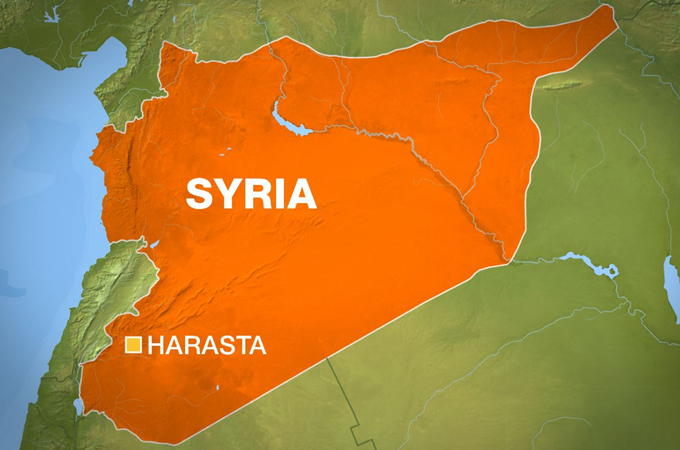
Members of the Free Syrian Army fired rockets and machine guns at a large air force intelligence complex situated in Harasta on the northern edge of the capital along the Damascus-Aleppo highway on Wednesday at about 2:30 am (0030 GMT), sources told Reuters.
Turkey halting joint oil exploration with Syria, threatens to cut energy supplies
Tuesday, 15 November 2011
Syrian opposition demonstrators living in Turkey hold a banner with pictures of Syria’s President Bashar al-Assad (R) and Libya’s Muammar Qaddafi (2nd R) during a protest against al-Assad outside the Syrian consulate in Istanbul Sept. 2, 2011. (Reuters)
Turkey said on Tuesday it was halting joint oil exploration with Syria and would consider cutting energy supplies to its one-time ally following attacks on Turkish diplomatic missions in three Syrian cities.
“Right now we are supplying electricity there (Syria). If this course continues, we may have to review all of these decisions,” Energy Minister Taner Yildiz told reporters.
Turkish Foreign Minister Ahmet Davutoglu said Syria’s leadership was offered a last chance to stop its violent repression of anti-government protests but rejected it.
“We have given a last opportunity to the Syrian regime but they didn’t want to seize it,” Davutoglu said in the Moroccan capital. Turkey wants “sanctions with an impact that spares harm to the Syrian people,” he said through an interpreter.
The White House, meanwhile, said that Turkish criticism of Syrian President Bashar al-Assad had deepened the isolation of his regime.
In 1968, socially and economically marginalised groups of people protested in a global movement [GALLO/GETTY]
The turmoil in Arab countries that is called the Arab Spring is conventionally said to have been sparked by the self-immolation of Mohamed Bouazizi in a small village of Tunisia on December 17, 2010. The massive sympathy this act aroused led, in a relatively short time, to the destitution of Tunisia's president and then to that of Egypt's president. In very quick order thereafter, the turmoil spread to virtually every Arab state and is still continuing.
Most of the analyses we read in the media or on the internet neglect the fundamental contradiction of this phenomenon - that the so-called Arab Spring is composed of two quite different currents, going in radically different directions. One current is the heir of the world-revolution of 1968. The "1968 current" might better be called the "second Arab revolt".
Its objective is to achieve the global autonomy of the Arab world that the "first Arab revolt" had sought to achieve. The first revolt failed primarily because of successful Franco-British measures to contain it, co-opt it, and repress it.
The second current is the attempt by all important geopolitical actors to control the first current, each acting to divert collective activity in the Arab world in ways that would redound to the relative advantage of each of these actors separately. The actors here regard the "1968 current" as highly dangerous to their interests. They have done everything possible to turn attention and energy away from the objectives of the "1968 current", in what I think of as the great distraction.
King Abdullah told an interviewer the Syrian president should begin new era of dialogue before resigning [Reuters]
Speaking to an international news agency, Jordan's King Abdullah has called for Bashar al-Assad, the president of Syria, to step down in the interest of the Syrian people.
"I believe, if I were in his shoes, I would step down," Abdullah told the British Broadcasting Corporation (BBC) on Monday. "I would step down and make sure whoever comes behind me has the ability to change the status quo that we're seeing."
Jordan has been critical of its northern neighbour Syria's crackdown on anti-government protesters in recent months.
King Abdullah, the first Arab ruler to issue such a call over the eight months of uprising, said Assad should usher in a new era of political dialogue before stepping down.
"Again, I don't think the system allows for that, so if Bashar has the interest of his country, he would step down, but he would also create an ability to reach out and start a new phase of Syrian political life," he told the BBC.
TRIPOLI, Libya — The present and future are daunting enough for the wobbly authorities here, but then there is the tormented past to consider as well: four decades of state crimes whose wounds demand attention.
MA section of the Abu Salim prison in Tripoli, Libya, once held political detainees. Libya must now balance the need to heal and calls for retribution. auricio Lima for The New York Times
With mass murders, disappearances and public executions, the victims of Col. Muammar el-Qaddafi’s People’s Court, Internal Security Agency and State Security Court number in the tens of thousands, human rights advocates here and abroad say. How will Libyans come to terms with their past?
Already, the provisional leaders are pondering options for exposing the long catalog of killings and torture, looking to models from South Africa, Europe and Latin America. They are motivated by a conviction, they say, that a new nation cannot be built unless light is shed on the dark corners of the old.
“Qaddafi did not leave anything behind except material and cultural destruction,” a former regime member said. Photograph by Platon.
EXCERPT:
During the long uprising in Libya, I toured the wreckage of Muammar Qaddafi’s forty-two years in power. There were the usual trappings of solipsistic authority—the armaments and ornaments—but above all there was a void, a sense that his mania had left room in the country for nothing else. Qaddafi was not the worst of the modern world’s dictators; the smallness of Libya’s population did not provide him with an adequate human canvas to compete with Saddam or Stalin. But few were as vain and capricious, and in recent times only Fidel Castro—who spent almost half a century as Cuba’s Jefe Máximo—reigned longer.
When is the right time to leave? Nicolae Ceausescu didn’t realize he was hated until, one night in 1989, a crowd of his citizens suddenly began jeering him; four days later, he and his wife faced a firing squad. Qaddafi, likewise, waited until it was too late, continuing to posture and give orotund speeches long after his people had rejected him. In an interview in the first weeks of the revolt, he waved away the journalist Christiane Amanpour’s suggestion that he might be unpopular. She didn’t understand Libyans, he said: “All my people love me.”
Beirut saw several sit-ins and protests against the Syrian state measures to quell the uprising there [Reuters]
After being on the run in his country for more than three months, Omar Edelbi, a Syrian poet and an outspoken critic of President Bashar al-Assad, managed to escape to neighbouring Lebanon - fleeing the Syrian government’s crackdown on dissidents.
Many intellectuals in the region call it the Arab world’s "bastion of freedom"; indeed, Lebanon initially appeared to be Edelbi’s best route out of Syria, given its proximity, its familiarity and the many illegal border crossings available.
But a few weeks after his arrival to Beirut, he started receiving death threats on his phone and via his friends. A couple of months later, he found himself at a branch of the Lebanese military intelligence service, undergoing a four-hour interrogation for "attempting to weaken relations between Syria and Lebanon" and for attempting to "disrupt the Lebanese national fabric".
"Those who come to Lebanon face the risk of psychological terror, physical terror, arrest and disappearance..." - Moeen Merebi, Member of Parliament
"The investigation led nowhere because they could not charge me with anything," said 41-year-old Edelbi, the spokesman of the Syrian Co-ordination Committees activist network. "But I believe the reason I was called for investigation is because they wanted me to stop what I was doing."
As many as 30 people have been killed by the fire of Syrian security forces and army troops on Friday, Al Arabiya reported citing Syrian activists.
Most of the victims were reported in the restive city of Homs as Human Rights Watch accused the regime of crimes against humanity.
The Arab League, meanwhile, held a ministerial meeting to discuss the Syria crisis which, according to the United Nations, has claimed more than 3,500 lives since protests against President Bashar al-Assad erupted in mid-March.
The deaths came amid mass anti-regime rallies demanding the Arab League suspend Syria’s membership in the pan-Arab body to sanction its brutal, eight-month crackdown on dissent.
Security forces broke up demonstrations in al-Malaab, a main thoroughfare in Homs, but rallies relocated and mushroomed, engulfing eight neighborhoods, including aAl-Bayada, al-Ghuta and Baba Amr, the Syrian Observatory for Human Rights said in a statement from Nicosia, according to AFP.
Musa Sadr went missing in Libya in 1978. His disappearance was a source of tension between Lebanon and the Qaddafi regime, which always maintained that the cleric left Libya for Italy. (Reuters)
Revered Lebanese spiritual leader Musa Sadr, who went missing in Libya in 1978, was “liquidated” at the time, a former aide to Muammar Qaddafi said Wednesday.
The fate of the Iranian-born Shiite cleric has been unknown since he vanished during a trip to Libya aimed at negotiating an end to Lebanon's 1975-1990 civil war.
Ahmed Ramadan, one of the most influential people in Qaddafi’s entourage, said Wednesday on Al-Aan television that Sadr disappeared following a meeting with the late Libyan dictator soon after arriving in Tripoli.
Prior to the arrival of UN soldiers in 2010, there were no reported cases of cholera in Haiti "for over 50 years" [EPA]
The United Nations has been hit with a demand for hundreds of millions of dollars in reparations because of a year-old cholera outbreak that has killed more than 6,700 Haitians.
The demand was made on Tuesday on behalf of more than 5,000 Haitian cholera victims and their families in a petition filed at UN headquarters in New York by the Boston-based Institute for Justice and Democracy in Haiti.
The human rights group said the peacekeeping soldiers were not adequately screened by the United Nations. The human rights group argues that infected UN peacekeeping troops from Nepal, where cholera is endemic, caused the outbreak by dumping untreated waste from their rural base camp into a tributary of the most important river in the earthquake-ravaged Caribbean nation.
"The cholera outbreak is directly attributable to the negligence, gross negligence, recklessness and deliberate indifference for the health and lives of Haiti's citizens by the United Nations and its subsidiary, the United Nations Stabilization Mission in Haiti (MINUSTAH)," the petition said.




 hanged since the Seventies, an equal amount hadn’t. The secret police still lurked outside houses in shiny new cars and cheap leather jackets, exuding tobacco smoke and violence. Phones were tapped, houses bugged. Sometimes people went missing, more often they lived with a constant, niggling anxiety. And Girgaresh was still known for the ‘butchers that don’t sell meat’ and ‘bakers with no bread’ where Libyans found guilty solace in bocha (date alcohol), for expats the key ingredient for the bojito, the Tripoli party tipple of choice.